Thursday, October 13, 2011

Putting ideas in their heads


If you've been paying attention, you'll know that this blog isn't just about animals that behave badly. It's often about humans who enable their bad behavior. And it doesn't get any worse than this story out of Japan.

What you see in the photo above is a movie screening held at Mt. Takasaki Natural Park in Kanzaki, Oita. (I'm being specific about this so you know exactly where it isn't safe to go if you visit this otherwise lovely, if cute-animal-obsessed, country.) For this event, a special condensed 13-minute version of the film was prepared, no doubt to account for the monkeys' short attention spans. The monkeys were served with special-occasion treats of grapes and bananas, and about 200 people and 400 macaques attended.

These efforts seem merely absurd until you find out exactly what these macaques were watching: It was the new Planet of the Apes movie. You know -- the prequel to the series, the one that shows how the monkeys take over the Earth.

You may poo-poo the notion that this movie will put ideas in these monkeys' heads. Macaques can't learn anything from movies, right? Not so fast. It's been shown, for example, that macaques can learn which are the high-status, dominant monkeys by watching films of them.

And don't forget that these filmgoers aren't just any monkeys. These are are the same macaques that have been known to terrorize and attack innocent civilians, hiding behind their reputation as the adorable "snow monkeys" that take Japanese hot-spring baths and play with snowballs.

You'd think Japan had had enough problems lately, why are they asking for trouble? Or could it be that they're so tired, they're ready to give up and let the monkeys take charge?


Thanks for the tip and translation from the Asahi Shimbun to the Kyoto bureau of Animals Behaving Badly.

Monday, October 10, 2011

Justifiable Bambicide


Sometimes I feel ambivalent about covering animals such as the bears in the last post. Surely nearly everyone knows to be afraid of bears, and there's much higher profile media putting its weight behind bear awareness. But so many are unaware that animals with a cute and cuddly reputation are just as likely to commit violent acts - and they're coming after us.

Take deer. Sure, they take a toll on our gardens, but they're so lovely and graceful and who can resist those cute spotted babies with the big Bambi eyes? Surely the only danger we have to worry about is hitting them with our cars, right?

Well, to start, deer are a threat even when your car isn't moving. In Massachusetts, one walked up to a vehicle and head-butted a man through the open window. “I saw cartilage or what I thought was cartilage -- a bone and blood just gushing all over my face,” he said, and ended up in the hospital for seven stitches and treatment of a broken nose.

But never mind cars: deers are walking right up to people's homes. An Ontario woman is being harassed by deer who ring her doorbell. Modifications to the doorbell button have not thwarted them, and when one morning these hooligans awakened her so early that she came to the door with her cane and cursed at them, the offending doe merely responded by snorting and scratching the ground threateningly.

Her nephew cautioned against confronting them - “Don't you know they could put a hoof right through you?" A wise warning, because not all deer who come to your house are merely pranksters, as a man in Ithaca, New York, learned.

Deer are a common sight on Tom Hartshorn's property, but he was clearly unaware of the risk they present: they'd often slept on his porch, and when his son was five, he was allowed to rub noses with a fawn.

So when he stepped outside and startled a buck that crashed through a window into his workshop, Hartshorn was unprepared for what followed.

"I went in thinking it would be like shooing a rabbit away," he said. "But the next thing I know, I am in the battle of my life."

Hartshorn entered and attempted to steer the eighty pound animal towards the door with a shovel, but it went after him. After a struggle managed to whack the deer on the head, and the blow was apparently fatal.

Frighteningly, this sort of incident is not as rare as you might think. A local expert says that he's called a couple of times a year about deer in buildings on the Cornell campus. He advises that you treat this situation like any other dangerous intruder: Call the police.

Hartshorn will no doubt take that advice next time. He never meant to commit Bambicide, he said, but he had no choice: "I was just defending myself. It was either me or the deer."


Your pets are not safe either - thanks for the warning to Flickr user CGP Grey.

Thursday, October 6, 2011

CSI: BEARS is not enough to protect us


Followers of bad animal news might have taken comfort in the fact that a grizzly in Yellowstone National park recently received the death sentence after DNA evidence linked it to the deaths of two hikers in separate attacks.

But less widely reported stories from across North America suggest that this is no time to become complacent about bears - even if you stay safely away from the wilderness. These animals are coming after us where we live:

-In Florida, the hunt is on for a bear that has been breaking into houses and stealing food. In one recent incident the bear got away with a birthday cake, prompting officials to set up a trap baited with cupcakes. So far, the bruin has not been tempted, perhaps because it's reading the news reports that helpfully warn of plans to euthanize the bear if it's captured.

-In Pennsylvania, Richard Moyer was letting his dog in late at night when a black bear rushed through the door and jumped him. As the two struggled on the living room floor, Moyer's wife tried to break it up, and the bear turned on her and dragged her outside. Eventually their combined counterattacks convinced the bear to retreat. "I know what it's like to be a salmon now," a bandaged-up Moyer joked - but also noted that one scratch had come within an inch of an artery: "If it had hit that, I wouldn't be here to tell the story."

-And in British Columbia, it wasn't a home that was invaded, but an institution almost as dear: a pizza parlor. Staff saw the bear checking out an outside garbage can but were afraid to get near enough to close the door, so it strolled right in and dove into a pie. Employees - as well as twenty spectators taking photos and video - watched as the bear ate four pizzas, reportedly including vegetarian, cheeseburger, and beef with blue cheese. While bears can't post online restaurant reviews, it apparently thought highly of the meal: it tried to come back twice the same night.

Monday, October 3, 2011

Biting the hand that rescues you


Perhaps appropriately for the week that THE BOOK is coming out (tomorrow!), there's so much bad animal news, it's hard to decide what to cover in detail. Just a few examples:

-The Ig Nobel prize that was awarded last week to research showing that a certain type of Australian beetle is happy to have sex with discarded beer bottles instead of female beetles - but only the brown bottles with little bumps on them.

-The coyotes that took over an abandoned house in Southern California.

-The news that escaped pets may be teaching wild parrots to talk, which, although derided by some skeptics, could have frightening implications if true.

But all of these take a back seat to what is clearly most significant recent news for the purposes of this blog. It's an update on one of those heartwarming animal stories that went viral - but that turns out to have a dark side.

By now everyone has heard the tale of Willow, the cat found in Manhattan that turned out to have disappeared five years ago from a home in Colorado. Willow's history was discovered when she was picked up on the street and brought to an animal shelter, where they scanned a microchip that revealed her true identity.

The story was covered in major media outlets across the country, with much wonderment over how a cat could have made the trip of many thousands of miles. There was rather less coverage of the prosaic explanation, that someone on a ski vacation had found the lost cat, assumed she was a stray, and flew her back to his Brooklyn home.

The family was reunited with Willow last week, when they flew to New York to pick up the prodigal pussy and, of course, make the rounds of media outlets. All very charming, till one news conference when Willow decided to make her real feelings known, as reported by the New York Post:
Spotlight-weary Willow the cat bit her 3-year-old owner yesterday as cameras rolled on their happy if painful reunion.

Little Lauren “Lola’’ Squires had barely finished cooing about how she couldn’t wait to get long-lost Willow home to Colorado -- gushing, “I’ll feed her, play with her, take good care of her” -- when the frustrated feline snipped at her hand.

Willow's owners downplayed the bite, saying that the cat was just "stressed out" by all the attention. They're sure she'll fit in when she gets home, where she will meet a strange dog they acquired after she left along with the strange child. Why so confident? They explained, “she’s very dominant . . . we used to say she acted more like a dog.”

We suspect we haven't heard the end of this story.

Thursday, September 29, 2011

Another adorable aquatic menace


What is it about being an aquatic mammal that messes with people's minds? Dolphins are not the only one of these sleek wet creatures whose reputation is far more positive than the reality. When you think of seals and sea lions, you no doubt think of cute circus tricks or those adorable fuzzy white babies - the ones that people all over the world banded to together to save from cruel slaughter for their fur.

This positive attitude is encouraged by gushing articles like this one, where a nature photographer thinks it's just perfectly adorable when a seal chews on her diving flippers and tries to eat a camera.

That article compares the seal to a playful puppy. Sure, the kind of cute puppy who drags helpless five-year-old children into the water, and kills scientists who've dedicated their lives to studying marine biology.

The private lives of these animals is also far from adorable. Like dolphins, they make a regular practice of sexual assault and infanticide. In one highly endangered seal species, one of the main threats to their survival is that the males have the habit of ganging up on females in breeding season so violently that they kill them. Not the best strategy if you're trying to perpetuate the species, guys.

And a couple of recent stories show that their more of their bad behavior is heading our way. In Prince Edward Island, Canada, Chris MacLeod and Mary MacDonald took their dogs to swim at the same beach they always do, but this time it led to tragedy:

On Aug. 27 one of their dogs, Dipstick, swam into the water. MacLeod said seals surrounded his dog, and stopped her from coming back to shore. MacDonald made an effort to swim out and clear a path for the dog, but failed.

"The seals were actually meeting Mary, and not letting her, more or less, go any farther and Mary was kind of scared," said MacLeod.

Unable to rescue their pet, the couple could do nothing but watch as the seals mobbed the dog for two hours till it drowned. And adding the usual insult to this painful injury, a naturalist consulted by the news media just made excuses, rationalizing that "seals are curious creatures and that might explain their behavior" and insisting that they "almost never" attack humans or dogs.

And it seems you're not even safe from these creatures anymore if you avoid the shore. In Victoria, Australia, a man looked out his window to see something shocking peering back:
A sea lion swam on to Dendy Beach in Brighton, made its way up the sand and beach stairs, waddled along the Esplanade, then crossed the road into the garden of Esplanade resident John Battersby.

Note that while Australia has a wide range of exotic wildlife, this is not a common occurrence. The neighbor who spotted the animal crossing the road at first thought it was a bear, which was apparently only a slightly less ridiculous theory than the truth. This is a part of the country where sea lions are spotted at most once or twice a year, and never - till now - on someone's front porch.

So if you live on the coast, watch your back. If they gang up with the dolphins, we're really in trouble.


PS: You'd know all that stuff about seals if you read the book. Also, that hard-won law that made it illegal to club baby seals to death? It only applies until they are twelve days old and start losing the white fur. I'm sure they think we've done them a HUGE favor.

Monday, September 26, 2011

Porcipcide most foul


Dolphins, again. Yes, I'd love to stop beating this aquatic dead horse and spend more time covering the bad behavior of other animals. But the battle against the absurdly positive reputation of these psychopaths of the sea continues to make little or no progress. So I would be remiss in not covering a recent story in the San Francisco Chronicle about the increasing number of dolphin attacks on harbor porpoises off the coast of northern California.

These smaller marine mammals pose no threat to dolphins and reportedly don't even compete for the same food sources. But as we've already noted, they are often beaten to death by dolphins, possibly gangs of sexually frustrated young males.

Dolphins didn't used to venture as far north as San Francisco. But in the last few years they've started to move in, so the neighborhood has gone rapidly downhill for the porpoise: there have been over 50 deaths since 2005, and of course, those are only the ones we know about, where the bodies have washed up on shore. Even the scientists are calling it "porpicide."

Here are the particularly heinous details of the attack on one recent victim:
It had two badly broken jawbones, fractured ribs on both sides and a broken scapula, evidence of a sadistic attack. Worst of all, the female porpoise, which had been seen twice before and identified by researchers in Monterey Bay, was lactating when she was killed, according to marine biologists.

And yet, while somewhere out there a motherless baby starves to death, what do we see but the release of yet another ridiculously positive and heartwarming dolphin movie.

Where are the porpoise-proponent protestors picketing this piece of propaganda? Where are the international organizations exposing the slaughter? If it's not OK for us to do this kind of thing, why do dolphins get a free pass?


Peruse more pictures of porpicide in progress at The SF Chronicle. And ponder: if you don't pass this post around, are you part of the problem?

Thursday, September 22, 2011

Vacation Linkarama


While I'm trying to relax at the beach despite having read the last story linked to below, enjoy some high quality bad animal reporting and analysis from elsewhere on the web:

A brave fellow at Gizmodo presents the evidence: Why we should just let the damn pandas go extinct, already

At the Guardian: That pet cat who turned up after five years - heartwarming tale or feline conspiracy?

A world traveller keeps track of the number of birds (and one bat) that have crapped on her

And before you laugh at that: Scientists implicate seagulls in the worldwide spread of antibiotic-resistant bacteria.

And now I'm off to the beach - no, on second thought, the nice bird-free outlet mall.

Monday, September 19, 2011

Our continuing coverage of Animals vs Infrastructure


Animals continue to attack the technological underpinnings of our society, and some of the perps are creatures that we never think of as a danger. In the latest case, traffic descended into chaos in the town of Darlington in northern England when traffic lights at a major intersection went dark. Investigation revealed that a slug had crawled into the control box and short-circuited the electronics.

Green and pleasant England frequently has trouble with slugs and snails that goes beyond a nibble on the herbs and lettuce in the garden. A couple of years ago, a particularly wet summer found these slimy invertebrates interfering with the mail, climbing into mailboxes and eating the contents. It's the glue that appeals to them, according to a Royal Mail spokesman: "They are particularly keen on stamps and air mail letters. Something in the dye attracts their taste buds."

And animals interfering with electricity is common all over the world. They often cause power failures, as we've seen here (raccoon, eagle) and here (snakes) and there was a recent case in South Carolina where the culprit was a squirrel (and hey, there are quite a few in the book, too),

They can also keep you from learning about their misdeeds on this blog by cutting off your internet access, such as the crows in Tokyo that slash open fiberoptic cable for nesting material. And when crews investigated an outage in rural Idaho, “They said that bears had been rubbing against the towers,” said one victim.

Sometimes these attacks on our technology are suicide missions. Moist invertebrates and electricity are a dangerous combinations, and the slug in the traffic box incident was described as "fried." You can see a picture of the result when an individual computer user was attacked in the same way, looking a bit more like "melted," here.

But we humans seem not to recognize our own vulnerability. A local official in Darlington commented:
Unfortunately, it was dead by the time we found it, so we were unable to question it. Sadly, you just can't legislate for a rogue slug trying to take out Darlington's traffic system.
Very funny. But if he read this blog, he might not be laughing. This isn't the first time we've reported on a British kamikaze slug taking out a traffic light. And in that case, someone died in a resulting accident.

I suspect these slugs aren't giving their lives for nothing. We'll continue to keep our eye on this slimy situation.


Photo of attacking slug by Flickr user ecstaticist.

Thursday, September 15, 2011

What happens when animals party too hard in the Internet age


Maybe you worry about who will see those party photos on your friends' Facebook pages. Well, ours isn't the only species who may wake up to find our drunken embarrassment plastered all over the Internet:
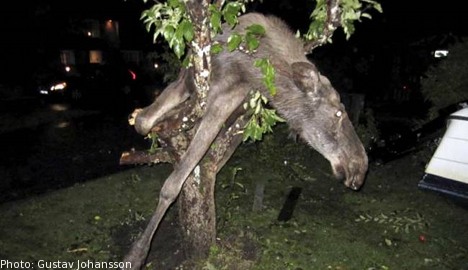
When Per Johansson of Särö, south of Gothenburg, returned home from work on Tuesday it was dark outside and the rain was coming down hard. Suddenly Johansson heard a bellowing noise from the garden next door.

“I thought at first that someone was having a laugh. Then I went over to take a look and spotted an elk stuck in an apple tree with only one leg left on the ground,” Johansson told The Local.

Johansson took pity on the animal and called for help. He and his neighbors tried to saw the branches to make it more comfortable, but it finally required the efforts of the fire brigade to get it out of the tree. Then, rather than running away like a respectable wild creature would, it lay on the ground:
According to Johansson, it looked very much like the elk was severely drunk after eating too many fermenting apples.

Drunken elk are common in Sweden during the autumn season when there are plenty of apples lying around on the ground and hanging from branches in Swedish gardens.

While the greedy animal was reaching ever higher to reach the delicious but intoxicating fruit, it most likely stumbled into the tree, getting itself hopelessly entangled in the branches.

And from what Johansson could gather, this particular animal had been on a day-long bender.

“My neighbour recognised it as the animal that almost ran into her car earlier in the day. She was pretty sure the elk was already under the influence,“ said Johansson.

The hungover elk finally dragged itself away the next morning and is no doubt trying to hide out as photos and reports of its predicament have gone all over the world.

Of course, readers of this blog know that there is nothing unique about this case. We've seen drunk birds, fruit flies, a deer, baboons, a badger, bees, and elephants. (In fact, there is a whole chapter about drunken and other substance-abusing animals in the book. Have you ordered your copy yet?)

But let's also not forget that the last time we reported on a drunk elk in Sweden, it was no laughing matter. In 2009, a man was jailed for ten days for the murder of his wife and only released when cleared by forensic evidence: hair and saliva found on the dead woman's clothes belonged to an elk. The motive was unclear, but police cited the aggressive tendencies of elk drunk on fermented apples.

Mr. Johansson may have meant to do a good deed, but I hope he is watching his back.

Monday, September 12, 2011

Don't say I didn't warn you


In 2009, a bear broke into a car in Colorado. Alerted by the car alarm and assuming a theft was in progress, the owners called the cops. When deputies arrived, they helpfully opened the car doors so the bear could escape.

In 2010, also in Colorado, officers didn't arrive till the bear had gotten a little further - this time it had driven the car out of the owner's driveway. These officers made sure to take photos to post on the Internet before, yes, opening the car doors so the bear could escape.

Now, it's happened again, in Lake Tahoe. Another bear managed to drive a car a short way, and this time, it got away on its own.

While the police in this recent case weren't active accomplices in the bear's escape - probably only because they didn't get the chance - they clearly took the incident just as lightly. A spokesman for the police department reportedly laughed when he said "Normally, you'll get reports of the Dumpster divers and trash divers, but bears breaking into cars is different."

And the owner of the car reportedly "had no clue why a bear would want to get inside his car," because there was no food inside.

People: Bears are teaching themselves to drive and you're not paying attention. When the bear army arrives, and you're surprised that they're in vehicles, don't say you weren't warned.


If only Patches was right that simple mauling was all we had to worry about.

Thursday, September 8, 2011

Another great American heroine


They warn you not to get between a mama bear and its offspring. But someone needs to tell bears that they better not get between a human woman and her beloved dog.

Last year we met a woman in Montana who saved her dog from a bear by hitting it with a zucchini. Now, an Alaskan woman is getting attention far and wide for rescuing her dog from a bear with her bare hands.

Brooke Collins let her dogs out as usual one evening, but then heard her dachshund Fudge barking, making “the most horrible sound in the world.”

And then, she told the Juneau Empire, she saw a bear crouched down, holding Fudge in his paws, biting his neck: “That bear was carrying her like a salmon.”

Collins didn't even have a vegetable to use for defense, but that didn't stop her: She ran up to the bear and punched it in the snout. It dropped the dachshund and she grabbed him and ran.

“It was all so fast. All I could think about was my dog was going to die,” she said. “It was a stupid thing but I couldn’t help it.”

Stupid or not - well, yes, stupid. But still, this woman's brave bare-handed stand against bad animals has grabbed the world's attention: she's been contacted by radio stations and newspapers around the world for interviews.

Collins says that her unexpected fame is a bit overwhelming and she kind of wishes it would go away. Well, she needn't worry - it will soon enough, her viral celebrity eclipsed by yet more photos of cute baby animals and heartwarming tales of unlikely interspecies friendships. But for a moment, for a change, the spotlight is on a story of a bad animal getting what it deserves - let's enjoy it while we can.

Monday, September 5, 2011

They've got her!


Cows have been up to all kinds of shennanigans lately, but the star of the season has been Yvonne. She escaped from a farm in Bavaria in May and spent the summer roaming the countryside, making fools out of the humans who couldn't catch her despite the latest high-tech search equipment. The situation caused conflict between groups with wildly varying approaches, from cops who wanted to shoot her to animal rights activists who thought she'd come running to them at a glimpse of one of her darling offspring.

But Germans can finally rest easy: Yvonne has been captured.

She didn't go down without a fight, of course. It took two tranquilizer shots - twice the normal dose - and even after that, rescuers struggled to get her into a transport truck. "She acted very aggressively," said a veterinarian. "She has the qualities of a Spanish Toro."

It seems like a happy ending for everyone. The farmer who spotted her got a €10,000 ($14,500) reward from a German tabloid, and Yvonne will live our her days at an animal sanctuary owned by a group that purchased her while she was on the lam, along with her sister and one of her calves.

And these cow-hugging activists - the ones who thought that appealing to her maternal nature would be enough to entice Yvonne to give up her freedom - happily say "The whole family is waiting for her."

I guess it's nice that some people have apparently had such an idyllic experience of family life. But does it really not occur to anyone that maybe that was exactly what Yvonne was trying to get away from?


See the rest of the photos of Yvonne's capture at Spiegel Online.

Thursday, September 1, 2011

Even dolphins are entitled to a defense


Today has been declared Save Japan Dolphins Day by people who want to stop dolphins from being fished for food in Japan. They encourage you to join them in protests at Japanese embassies around the world.

The last thing dolphins needs is more publicity. But this blog, as an almost-lone voice against dolphin worship, can't let the event pass without comment.

Defenders of dolphins are usually people with romantic notions about animals. They think that animals are better than we are, that we're the only species that commits acts of senseless violence. They're definitely not readers of this blog, where we have repeatedly documented the facts:

-Male dolphins form aggressive gangs to chase down female for sex.

-They sexually harrass females of another species as well - our own.

-They kill babies - the young of harbor porpoises as well as their own,
and recent studies suggest this is done by sexually frustrated young males.

-They kill adult harbor porpoises as well.

Yet people are so unable to believe that these animals are ill-intentioned that their ignorance may put them in danger. People continued swimming out to play with a dolphin called Moko in New Zealand even after many had to be rescued from his aggression by lifeguards, and when he died he was given a funeral by those who continued to defend him.

Now, none of this is meant to defend the slaughter of these animals. I'm just saying that the main reason to stop it is this: we shouldn't lower ourselves to their level.

Dolphins may be no better than we are, but we live in a civilized society, where even murderers are entitled to a defense lawyer. So protest all you want, but remember, when you watch celebrity endorsements of the claim that dolphins save lives - we never hear from the people the dolphins push AWAY from shore.


Dolphin taking a smoke break - you know they would if they could - by Natalie Dee.

Monday, August 29, 2011

Marsupial with a fetish


Due to post-hurricane limited-internet-access crisis, I present this story from Digital Spy in its entirety without comment:

A kangaroo named Benji reportedly angered several neighbours in Prague after he was caught 'stealing' their underwear.

The 2-year-old marsupial is said to have escaped his owner before hopping over several gardens. He was only caught after a neighbor spotted him jumping away with his loot of lingerie.

Benji's owner had already reported him missing to police, but a spokesperson revealed that separate calls of stolen clothing were not linked at first.

"We had a call from Benji's owner saying his pet kangaroo had escaped," the spokesman said. "At the same time we started getting reports of a number of thefts from washing lines.

"We didn't think they could possibly be related until he was caught red-handed."

Benji's owner Petr Hlabovic, 35, said: "I'm very relieved to have him back. I've got no idea what he thought he was up to - he certainly didn't pick up the habit from me."


Photo of the culprit reluctantly being taken into custody from Metro.

Thursday, August 25, 2011

Masked bandits join forces


In Sweden, they're bracing for an invasion of masked criminals - and it's going to be worse than they were anticipating.

Raccoon dogs have spread from their native lands in East Asia into Europe, and although they're rather adorable, the result isn't pretty.

The raccoon dog (Nyctereuctes procyonoides) is not related to raccoons, but is a canine distantly related to domestic dogs. It's named in English for its resemblance to the familiar North American masked animal.

They're particularly prominent in the folklore of Japan, where they are called tanuki. Just looking at their role in traditional tales, one might be unnerved about the prospect of having them immigrate.

They have a reputation as tricksters, but this sometimes goes farther than practical jokes. They can change shape, and can disguise leaves as money to get sake and food from unsuspecting humans. They are known for making bizarre use of their scrotum, which they can enlarge into a huge sheet to use in various ways, such as as a blanket or a boat. They disturb the peace in the evenings by drumming loudly on their belly and balls. But in one region they're also famous for recurring wars, and there is at least one traditional tale where they kill an old woman.

Fairy tales, sure - but the reality is turning out to be even more destructive. In Finland, they're reportedly wiping out wetlands birds and frogs - and they manage to do so despite the fact that 100,000 are shot per year.

They've established themselves in Denmark as well, and now neighboring Sweden is next. The waters separating the two countries are not enough to deter the tanuki, which are good swimmers. It's feared that they're bringing rabies and tapeworm along with their prodigious appetites.

But, you might say, they could be relieved that at least they're not raccoons, right? We don't need folklore to know that raccoons commit violent assaults on humans and dogs, invade homes, and even take advantage of bad economic times to take over property.

Ah, but not so fast. When Sweden installed cameras along the border to monitor for the presence of raccoon dogs, they found large numbers of raccoons as well.

Raccoons are not native to Europe, so where did this invasive species come from? Many are descended from four raccoons set free in Germany in the 1930s by Herman Göring.

So: shapeshifting canines and Nazi raccoons. Sweden, we wish you luck.


Traditional well-endowed tanuki statue by Flickr user anjuli ayer.